
Most people don’t really see janitors.
They walk past with their eyes fixed on phones, shoes clicking across freshly mopped floors. They leave behind paper towels on sink counters and coffee rings on desks, assuming someone else will always clean it up. Someone invisible. Someone replaceable.
I stopped expecting to be noticed a long time ago.
My name is Martha. I’m sixty-three years old, and for more than four decades, I’ve worked nights. Quiet hours. The kind of hours when office buildings breathe differently, when rest stops hum softly under fluorescent lights, and when the world finally slows down enough for you to hear your own thoughts.
Some people call that kind of life lonely.
I never argued with them.
But I never fully agreed either.
There’s dignity in honest work. And there’s peace in silence when the rest of the world sleeps.
Still, I’d be lying if I said I didn’t hope for small things. When you give your body, your time, and your youth to raising children, you secretly hope that one day it circles back. A visit. A phone call. A birthday card signed in crooked handwriting by a grandchild you’ve only seen in photos.
Mine stopped coming.
I have three children. Diana. Carly. Ben. All grown. All successful. College degrees framed on walls I’ve never stood in front of. They have partners, children, bright kitchens with stone countertops and refrigerators stocked with wine and sparkling water.
And me?
I’m the chapter they quietly closed.
Holidays come and go like wind down an empty street. The reasons change every year, but the result never does.
“Flights are too expensive right now, Mom.”
“The kids have activities.”
“We’re spending the holidays with the in-laws.”
“Next year, okay?”
Next year never comes.
So I keep working. I keep cleaning the world they move through, even if they’ve forgotten the woman who helped build it.
That’s why I was at the interstate rest stop early that Tuesday morning. Halfway through my shift. Alone. The sky outside still pitch black, the tile floor cold beneath my shoes as I pushed my mop back and forth.
That’s when I heard it.
At first, I thought it was nothing. A faint, broken sound. Almost like a stray kitten caught somewhere it shouldn’t be.
I froze.
Then it came again.
A thin, desperate cry that didn’t belong in an empty restroom.
My heart started pounding so hard I thought it might drown out the sound. I dropped the mop and followed the noise, step by careful step, toward the far wall.
Behind the second trash bin. The one that always overflowed first.
I pulled it aside and knelt down.
And there he was.
A newborn baby boy.
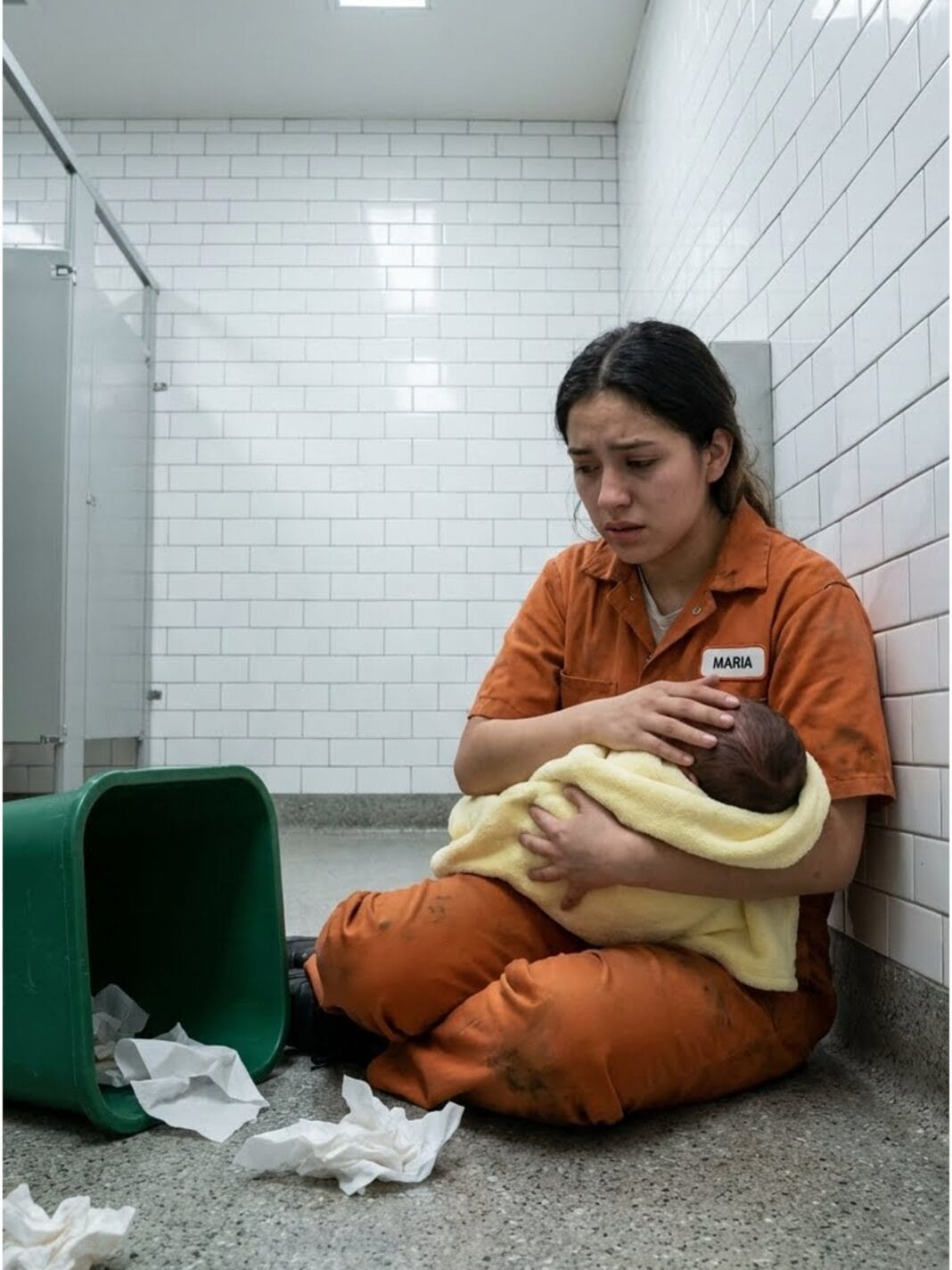
So small. So frighteningly still. Wrapped in a dirty, threadbare blanket, tucked between torn paper towels and empty snack wrappers. Someone had placed a faded navy hoodie beneath him, as if that tiny mercy could make up for everything else.
He was alive.
Barely.
I didn’t think. I didn’t hesitate. I scooped him into my arms and pressed him against my chest, instinct taking over before fear could catch up. His skin was cold. His body trembled.
And in that moment, standing on a bathroom floor that smelled of bleach and disinfectant, something inside me shifted.
For the first time in years…
Someone needed me.
There was a note tucked into the blanket. I unfolded it with shaking fingers.
“I couldn’t do it. Please keep him safe.”
“Oh, sweetheart,” I whispered, tears blurring my vision. “Who could leave you like this?”
The baby didn’t answer, of course. His tiny fists just clenched tighter, as if holding on to the only warmth he could find. I wrapped him in my work jersey, my hands rough and damp, my uniform smelling of chemicals.
None of that mattered.
“I’ve got you,” I murmured. “You’re safe now. I’ve got you.”
The bathroom door creaked open behind me.
I turned quickly.
A man stood frozen in the doorway. A trucker. Tall. Broad-shouldered. His face was lined with exhaustion, dark circles under his eyes like he hadn’t slept properly in days.
His gaze dropped to the bundle in my arms.
“Is that… a baby?” he asked, his voice cracking.
“Yes,” I said firmly, adjusting the fabric around the boy. “He was behind the trash bin. I need you to call 911 right now. His body’s cold.”
The man didn’t ask questions. He stepped forward immediately, pulling off his jacket and handing it to me before dialing his phone. A name patch on his shirt read Tim.
“He’s alive,” I said, more to myself than anyone else. “But he’s fading. Please hurry.”
Tim knelt beside me, relaying everything to the dispatcher with surprising calm.
“We’re at the I-87 rest stop. A newborn has been found. The janitor is keeping him warm. He’s breathing, but weak.”
Minutes felt like hours.
When the ambulance finally pulled in, the paramedics moved fast, wrapping the baby in warm foil and lifting him gently from my arms. One of them looked at me and shook his head.
“You’re lucky you heard him,” he said. “Another hour, and this could’ve gone very differently.”
I climbed into the ambulance without thinking.
At the hospital, they called him John Doe.
But in my heart, he already had a name.
Little Miracle.
The social workers came soon after. One of them, a woman with kind eyes named Tanya, was honest with me from the start.
“Martha,” she said gently, “you work nights. Long hours. No agency is going to approve a placement like that.”
“What if I changed it?” I asked. “What if I cut back?”
She looked surprised.
“You’d do that?”
“Yes,” I said without hesitation. “I’ve spent my life doing for people who never said thank you. I can do more for someone who hasn’t even had a chance yet.”
And I meant it.
I cut back my hours. Let go of contracts. Sold my coin collection. Dipped into savings I’d been holding onto for years. It wasn’t glamorous, but it was enough.
Six months later, Tanya returned. She stood in the small nursery I’d put together and slid a pen across the table.
“If you’re still sure,” she said softly, “we can make it permanent.”
“I’m sure,” I said. “I want him forever.”
And just like that, the baby found behind a trash bin became my son.
I tried to tell my children.
Diana sent a thumbs-up emoji.
Carly didn’t respond.
Ben texted, “I hope that’s not permanent.”
But it didn’t matter.
I had a baby to raise again.
And a second chance I never knew I was waiting for.
To be continued in Part 2.