
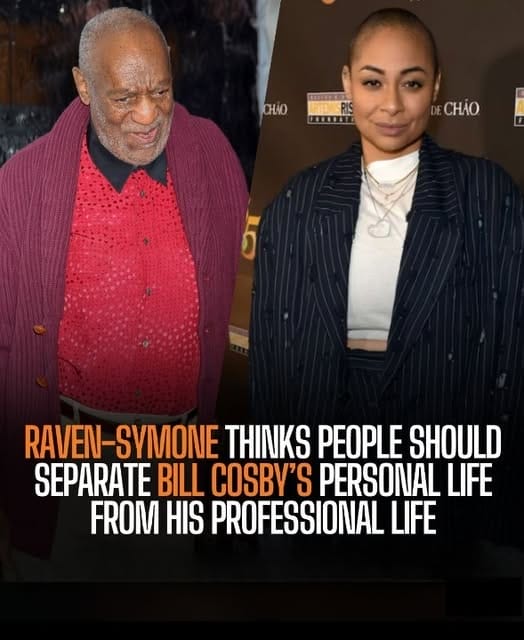
Raven-Symoné recently shared her thoughts on the ongoing debate surrounding how the public views Bill Cosby’s legacy, suggesting that people should distinguish between an individual’s personal life and their professional contributions. Her comments quickly sparked discussion, as they touched on a long-standing and deeply sensitive topic within entertainment and cultural history.
In her remarks, Raven-Symoné acknowledged that Bill Cosby has faced serious allegations that have deeply affected how he is perceived. She emphasized that these accusations are severe and disturbing, and she made it clear that recognizing professional accomplishments does not mean excusing or dismissing personal actions. Instead, she encouraged people to hold both realities separately and thoughtfully.
According to Raven-Symoné, separating personal conduct from professional work allows for a more nuanced understanding of history. From her perspective, Cosby’s contributions to television, comedy, and representation in media played a significant role in shaping opportunities for many performers, particularly within Black entertainment. She suggested that recognizing this influence does not require approval of his personal behavior.
Her comments highlight a broader cultural debate that often arises when influential figures face serious accusations. Many people struggle with how to reconcile meaningful artistic or professional contributions with deeply troubling personal conduct. Raven-Symoné’s viewpoint reflects one approach to this dilemma: acknowledging impact and legacy while still recognizing harm and accountability.
Supporters of her perspective argue that history is complex and that erasing professional achievements can oversimplify the past. They believe it is possible to critically examine someone’s work, understand its cultural significance, and still condemn harmful actions. From this angle, separating the two is not about minimizing wrongdoing, but about preserving historical context.
Critics, however, feel that such separation can be difficult or even inappropriate, especially when the individual’s public platform and influence were built alongside unchecked power. They argue that personal conduct and professional success are often intertwined, and that acknowledging achievements without fully addressing harm can feel dismissive to those affected.
Raven-Symoné’s comments also raise questions about how society chooses to remember public figures. In an era where accountability and transparency are increasingly emphasized, many people are re-evaluating how legacies are discussed, taught, and celebrated. Her statement reflects the tension between honoring progress in entertainment and confronting painful truths.
It is important to note that Raven-Symoné framed her opinion as a personal perspective rather than a universal rule. She did not suggest that others must view the situation the same way, but instead shared how she individually approaches the topic. This distinction underscores that conversations about legacy, accountability, and forgiveness are deeply personal and often shaped by lived experience.
Ultimately, Raven-Symoné’s remarks contribute to an ongoing and evolving dialogue about morality, art, and history. Her comments encourage reflection on whether it is possible—or appropriate—to compartmentalize personal actions and professional impact. As society continues to grapple with these questions, her perspective serves as one of many voices in a complex conversation about how we understand influential figures and the lasting effects of their work.