
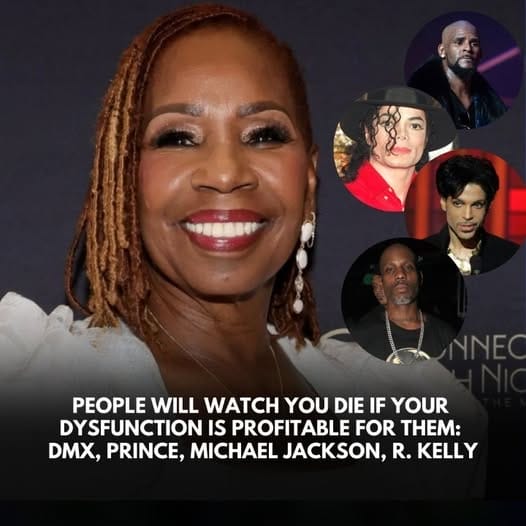
Iyanla Vanzant recently shared a powerful and unsettling perspective on the entertainment industry, suggesting that the world watched iconic artists such as R. Kelly, Michael Jackson, Prince, and DMX slowly unravel because their personal struggles were financially beneficial to others. Her reflection challenges audiences to look beyond fame and talent and examine how pain, instability, and unresolved trauma can become commodities in a system driven by profit.
According to Vanzant’s viewpoint, these artists were not just individuals battling internal challenges; they were also brands generating massive revenue. Their music, performances, and public personas created wealth for record labels, executives, promoters, and media outlets. As long as the success continued, the deeper issues surrounding their well-being were often ignored, minimized, or reframed as part of their mystique rather than warning signs that demanded intervention.
This raises a difficult question about protection versus exploitation. In many cases, the industry had the resources, access, and influence to support these artists in healthier ways. Instead, their struggles were sometimes tolerated, normalized, or even quietly encouraged because controversy and chaos kept attention high and profits flowing. The more unpredictable the artist became, the more headlines were generated, and the more money circulated.
Vanzant’s observation also speaks to the isolation that fame can bring. Artists at this level are often surrounded by people who rely on their success for income. When livelihoods depend on one person continuing to perform, speak, and produce, honesty can disappear. Few are willing to challenge harmful behavior or suggest stepping away when doing so might interrupt financial gain. This creates an environment where accountability is delayed or avoided entirely.
At the same time, the question of personal responsibility cannot be ignored. Artists are adults with agency, and their choices still matter. However, responsibility becomes complicated when power dynamics are uneven. When someone is young, vulnerable, or emotionally unprepared for fame, the people with more experience and authority carry added responsibility. Guidance, care, and boundaries should be part of management, not optional extras.
The public also plays a role in this cycle. Fans often consume music, interviews, and performances without questioning the cost to the person creating them. When breakdowns are treated as entertainment or gossip, it reinforces a system that rewards exposure rather than healing. Vanzant’s words challenge audiences to reconsider what they support and why.
Her statement invites reflection on when responsibility should shift. Early in an artist’s career, guidance from the industry is crucial. As success grows, so does the obligation to protect mental, emotional, and physical health. When warning signs are obvious and ongoing, continued profit without intervention becomes a form of neglect. At that point, responsibility no longer rests solely with the artist.
Ultimately, Iyanla Vanzant’s perspective asks a deeper moral question: how much suffering is society willing to overlook for entertainment? The stories of these artists serve as reminders that talent does not replace the need for care, and success does not eliminate vulnerability. If the industry continues to benefit from pain without accountability, the cycle will repeat.
Her message is not just about the past, but about the future. It calls for a cultural shift—one where artists are valued as human beings first, not products to be used until they have nothing left to give.