
At Davos, a World Pushes Back as Trump Escalates Trade Wars and Territorial Threats
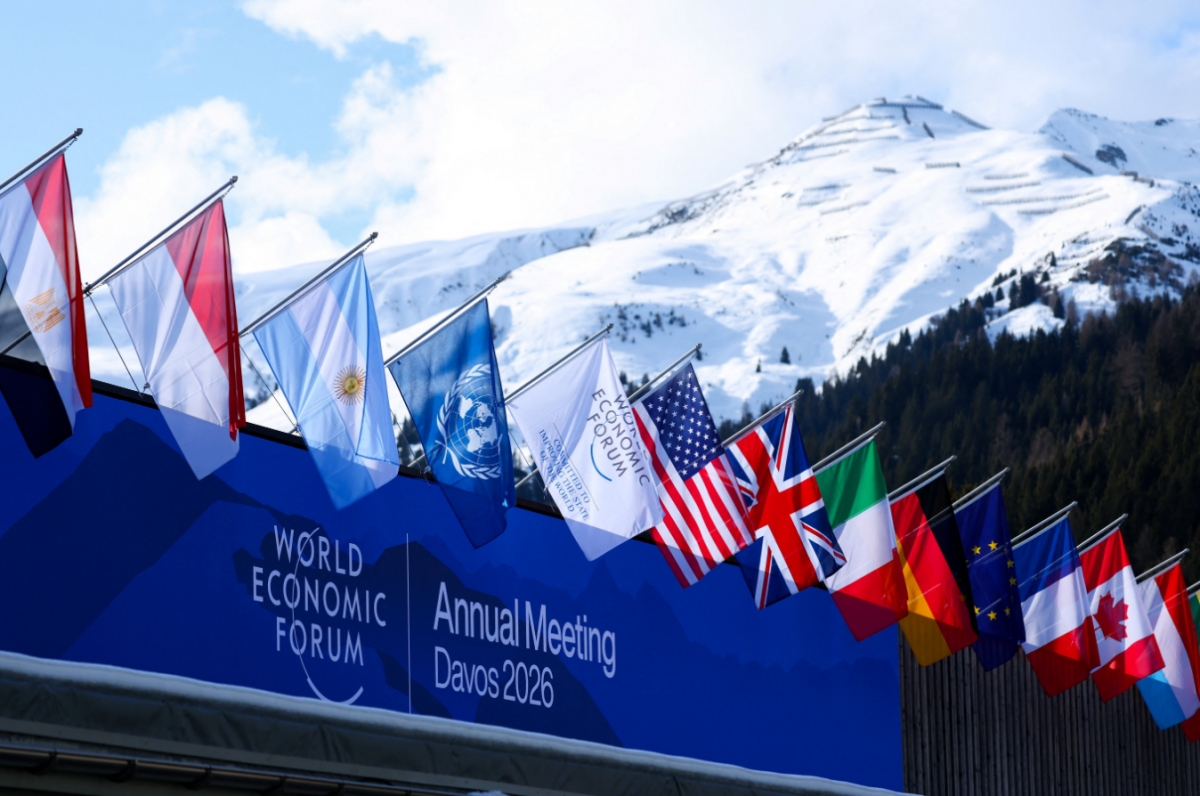
Davos, Switzerland — As global elites gathered this week at the World Economic Forum in Davos, the mood was tense, unsettled, and unusually candid. The annual meeting, long criticized as a polite ritual of elite consensus-building, instead became something closer to a collective intervention: a forum where world leaders, executives, and policymakers struggled to respond to an American president who has once again placed the global economic and security order under strain.
President Trump, preparing to arrive in Davos himself, dominated the discussions even before setting foot in Switzerland. His renewed threats of sweeping tariffs against allies, coupled with repeated rhetoric suggesting U.S. control over Greenland — a Danish territory and NATO ally — cast a long shadow over the proceedings. The result was a rare spectacle: European leaders, Canadian officials, and U.S. political figures openly warning that the rules-based international order is no longer merely eroding, but actively being weaponized.
A Private Message Made Public
The most striking symbol of the moment came not from a speech, but from a social media post.
Late at night, President Trump published what he described as a private message from French President Emmanuel Macron on Truth Social. In it, Macron expressed alignment with Trump on Syria and Iran but questioned his posture on Greenland, proposing diplomatic talks, a G7 meeting, and even a dinner in Paris. Trump’s decision to publicize the exchange appeared intended to signal personal leverage — proof, in his telling, that world leaders still sought his favor.
To many diplomats and analysts, however, the post reinforced a different concern: that even private channels of diplomacy are now vulnerable to domestic political theater. Several European officials privately described the episode as chilling, noting that it could discourage frank communication at precisely the moment it is most needed.
Europe’s Uneasy Rebuke
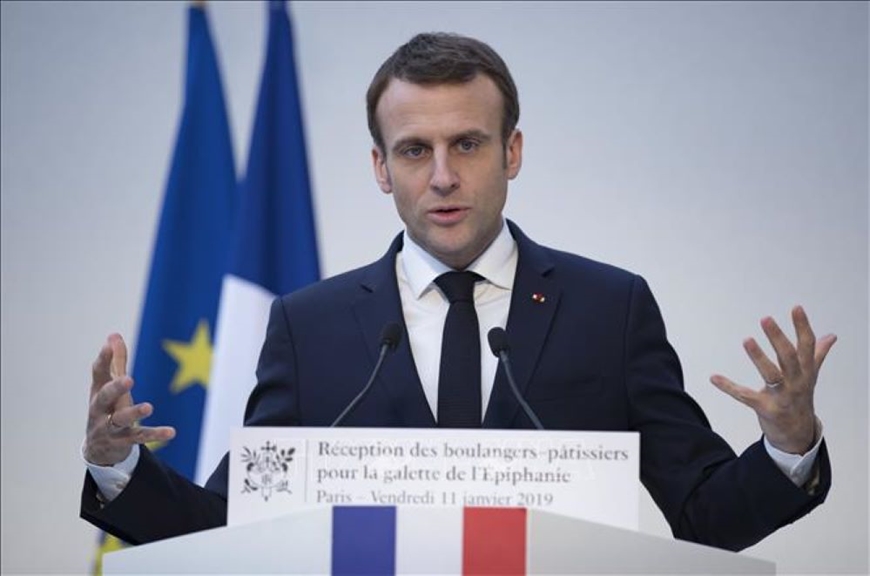
When Macron took the stage in Davos, his message was unusually direct. Without naming Trump, he warned of a global shift toward “a world without rules,” where international law is “trampled underfoot,” multilateral institutions are weakened, and power increasingly belongs to those willing to use coercion.
He cited escalating tariffs, economic pressure tied to territorial sovereignty, and the return of “imperial ambitions” as destabilizing forces — remarks widely understood as referring to Washington as much as Moscow.
Other European leaders echoed the concern. The president of the European Commission stressed that Arctic security “can only be achieved together” and warned that new tariffs between longstanding allies violated both trade agreements and trust. “In politics, as in business,” she said, “a deal is a deal.”
The message was clear: even allies who share security goals now fear that economic integration itself has become a liability rather than a mutual benefit.
Canada’s Blunt Assessment
Canada’s prime minister offered perhaps the starkest diagnosis. Speaking at Davos, he argued that the long-standing fiction of a fair, rules-based international order — one underwritten by American leadership — no longer holds.
“For years, we participated in the rituals,” he said, acknowledging that enforcement of trade rules and international law had always been uneven. But now, he argued, great powers were openly using tariffs, supply chains, and financial systems as weapons. “This bargain no longer works,” he said. “We are in the midst of a rupture, not a transition.”
The remarks were widely circulated on social media, praised by some analysts as overdue honesty and criticized by others as a sign of deepening transatlantic fracture.
U.S. Officials Deflect, Repeat Talking Points
While foreign leaders spoke in increasingly stark terms, U.S. administration officials offered a different posture. Treasury Secretary Scott Bessent and Commerce Secretary Howard Lutnick both urged allies not to “escalate” tensions and insisted the president had a coherent strategy.
Asked repeatedly about Greenland, Lutnick declined to engage, repeating that the “Western Hemisphere is vital” to U.S. security and that discussions would be handled by national security officials. Critics noted that the response avoided the central issue: why a NATO ally’s territory had become a subject of public American speculation at all.
Bessent, meanwhile, framed tariff disputes as manageable misunderstandings, urging patience and calm — an argument that resonated poorly with European officials who have already absorbed multiple rounds of policy reversals.
An American Rebuke from Within
Perhaps most striking was the criticism coming from fellow Americans.
California Governor Gavin Newsom, attending the forum, accused world leaders of being too accommodating. “It’s time to stand tall,” he said, condemning what he described as complicity and private complaints unaccompanied by public resolve. His remarks — laced with sharp rhetoric — went viral, reflecting a growing divide within the United States itself over how to respond to Trump’s approach.
On CNN, Senator Ruben Gallego went further, calling the president a “madman” and rejecting the idea that there was an “off-ramp” to de-escalation. When pressed on whether he meant that literally, Gallego did not retreat. The exchange underscored how language once considered taboo in mainstream political discourse has become normalized.
The Greenland Question
Behind the rhetoric lies a serious strategic concern. Greenland sits at the center of Arctic security, climate change, and emerging trade routes. But diplomats note that even discussing territorial acquisition through pressure or force — particularly against an ally — undermines core postwar norms.
Trump has repeatedly framed the issue in transactional terms, sometimes tying it to grievances such as the Nobel Peace Prize or trade concessions. To critics, this reinforces fears that U.S. foreign policy is being driven less by strategic consensus than by personal symbolism and grievance.
A Fractured Order

The Davos gathering made one reality difficult to ignore: the postwar system, already strained by pandemics, wars, and climate shocks, is now facing its most serious test from within the alliance that once sustained it.
Whether the United States ultimately retreats from confrontation or deepens it remains uncertain. But for many in Davos, the question was no longer whether the global order is changing — it is whether the world can adapt fast enough to a United States that no longer sees stability, predictability, and restraint as virtues.
As one European diplomat put it quietly on the sidelines, “We used to worry about the collapse of the rules. Now we worry about who is tearing them up — and why.”