
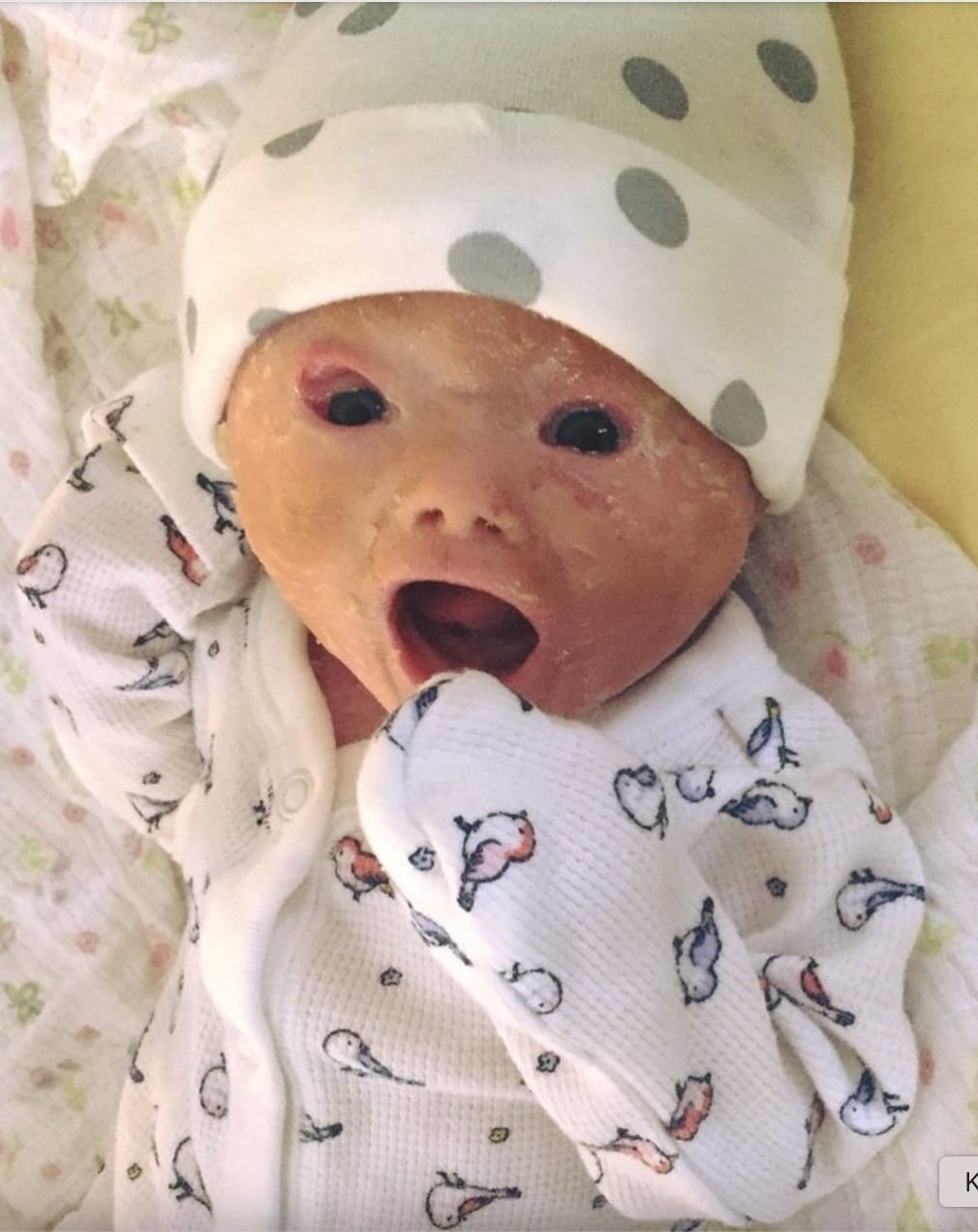
Jennie Wilklow expected the same moment every mother hopes for—the rush of relief when her newborn is placed safely in her arms. After months of worry, discomfort, and counting down the days, that single moment usually makes the entire journey worth it. But for Jennie, that moment never came. Instead, the birth of her daughter, Anna, began with confusion, fear, and the shattering realization that her child’s life would not resemble the safe, predictable future she had imagined…
Her pregnancy had unfolded without any red flags. Every appointment, every scan, every cheerful reassurance from doctors painted the same picture: a healthy baby on the way. Jennie and her husband let themselves dream about their daughter’s future, completely unaware that their world was about to change forever. When Jennie suddenly required an emergency C-section at 34 weeks, she feared the usual complications from premature birth—breathing issues, underdeveloped organs, maybe a stay in the NICU. Nothing could have prepared her for what actually happened.
The delivery began with hope. Jennie heard a cry, strong and clear. A nurse even whispered, “She’s beautiful,” and for a fleeting moment, everything felt right. Jennie let herself believe the ordeal was over. But within seconds, the room transformed. The shift was silent at first—stiffened posture, urgent glances, then a rapid, coordinated flurry of medical orders. The staff wasn’t focused on Jennie anymore. Their attention had locked onto the newborn, whose skin was undergoing a terrifying transformation right before their eyes.
Anna’s skin was hardening—literally turning rigid—seconds after birth. As it tightened, it cracked. Deep, painful fissures spread across her body like breaking ice. Her tiny mouth was pulled into a fixed ‘O’ shape. Her eyelids struggled to close. Nurses scrambled to protect her from infection, dehydration, and the unbearable discomfort caused by her own skin. Jennie, groggy and disoriented from surgery, didn’t yet grasp the severity. She kept asking if everything was okay, and the doctor’s vague reassurance was enough to hold back her panic—until she was sedated.
When she woke several hours later, her new reality was waiting for her.
A doctor explained that Anna had been born with Harlequin ichthyosis—a rare, severe genetic disorder that causes the skin to grow 14 times faster than normal. Babies with this condition historically did not survive more than a few days. The thick plates of skin they are born with make breathing, eating, and fighting off infection incredibly difficult. Jennie looked to her husband for comfort, but he could barely speak. The doctor left, and he finally managed, “This is bad.” Those three words crushed her.
The next forty-eight hours were filled with frantic searching. Jennie read everything she could find: medical journals, survivor stories, heartbreakingly short obituaries. The prognosis felt impossible to bear. Her baby, whom she had imagined laughing, walking, going to school—now seemed destined for a painfully short life. At her lowest, Jennie admitted she wondered if it might be kinder for Anna not to suffer at all. It is the kind of thought only a mother pushed to the edge of despair can understand.
But Anna wasn’t finished fighting. She defied the statistics. Hour by hour, she hung on. Then she improved. Days became weeks. Nurses began calling her a miracle. Her parents made a promise the moment they brought her home: if she was willing to fight for her life, they would fight just as fiercely to give her the best one possible.
Caring for Anna required nonstop attention. Her skin needed to be coated in petroleum jelly every two hours to prevent cracking. She needed long, soaking baths multiple times a day. Temperature changes, friction, even clothing could cause pain or damage. Still, Jennie found herself grieving something seemingly small—she wanted to dress her daughter in cute baby outfits like every other mother. That tiny dream symbolized a normal childhood, and she couldn’t let go of it.
Over time, something in Jennie shifted. Grief turned into resolve. Instead of focusing on what Anna might never do, she began focusing on what Anna could do—and would do. If Jennie lowered the bar to match the world’s assumptions, then Anna’s entire future would shrink around those limits. So Jennie raised the bar. Anna would not grow up believing she was fragile or excluded. She would grow up believing she was capable.
Jennie created an Instagram account to document their journey, not for attention but for connection. She wanted the world to see her daughter—not the condition, not the fear, but the incredible little girl who had already beaten so many odds. She wanted to educate, to show other parents facing similar diagnoses that life could still be full of joy. Anna’s personality—bright, expressive, mischievous—began shining through the photos and videos Jennie shared. Followers didn’t just see a medical condition. They saw a child.
Looking at Anna now, Jennie no longer wonders, “Why us?” The answer became clear. “I got her because of the love I already had in my heart,” she says. “Anna was meant for me, and I was meant for her.” What once felt like a cruel twist of fate revealed itself as an unexpected calling—to show the world the beauty in differences, to redefine what strength looks like, to prove that even the most difficult beginnings can bloom into extraordinary lives.
Anna continues to grow, learn, and surprise everyone who meets her. She is living proof that a diagnosis is not a destiny. Every day she thrives is a reminder that love, resilience, and hope can reshape even the harshest path. And Jennie continues sharing their story, not for sympathy, but to amplify a truth the world often forgets: beauty is not perfection. Beauty is courage. Beauty is survival. Beauty is a little girl whose skin hardened minutes after birth—but whose spirit, and mother’s love, proved unbreakable.