
Three Men Survived 11 Days Clinging to an Oil Tanker’s Rudder Across the Atlantic
Their extraordinary journey from Nigeria to the Canary Islands exposed the terrifying risks faced by migrants seeking a better life
For eleven days, three men from Nigeria lived through conditions that would be almost impossible for most people to imagine.
They were not traveling inside a ship.
They were not protected from the weather.
They had no cabin, no proper food supply and almost no protection from the enormous Atlantic Ocean beneath them.
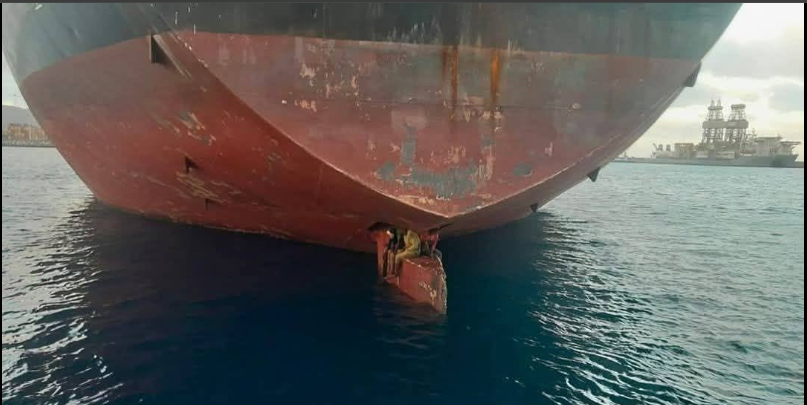
Instead, they reportedly remained hidden on the exposed rudder of a massive oil tanker traveling from Lagos, Nigeria, toward Spain’s Canary Islands.
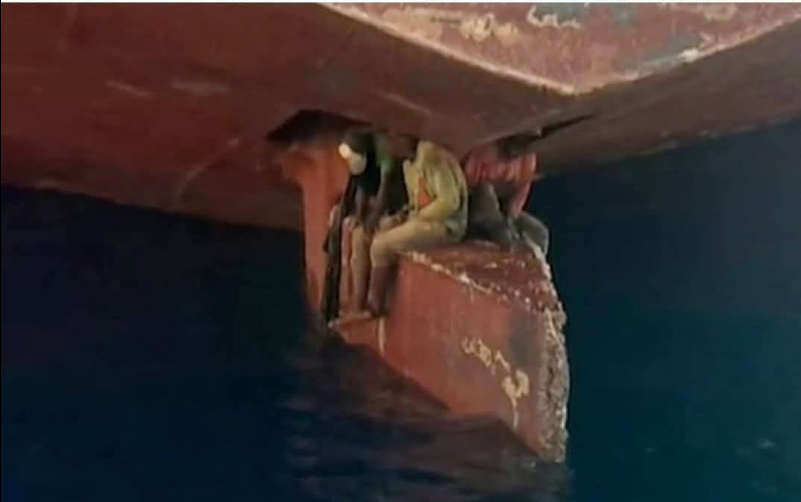
For more than a week, they clung to a narrow metal structure at the stern of the vessel, suspended only a short distance above the water.
Their survival was extraordinary.
And when the tanker finally reached the port of Las Palmas, Spanish authorities discovered the three men in a place where they were never supposed to have survived the journey.
A Dangerous Decision at the Port of Lagos
The journey began in Lagos, Nigeria, where the oil tanker Alithini II was preparing to leave port.
According to reports about the incident, the three men managed to hide at the rear of the vessel before it departed.
They eventually positioned themselves on the ship’s rudder.
The decision was incredibly dangerous.
A ship’s rudder is a mechanical structure designed to control the direction of the vessel. It is not a passenger area, and it provides virtually no protection from the elements.
From their position, the men were exposed to the open air and ocean throughout the voyage.
Once the tanker moved away from the African coast, returning to land would no longer have been possible.
They were committed to the journey.
More Than 2,700 Miles HIS Across the Ocean
The tanker traveled thousands of miles toward the Canary Islands.
For the three men, every mile represented another test of endurance.
The ocean beneath them was constantly moving.
Large waves could crash against the stern of the tanker, sending spray over the men and soaking their clothing.
Strong winds made their exposed position even more dangerous.
During the day, they faced the heat and intense sunlight.
At night, temperatures could fall dramatically, leaving them cold and exhausted.
There was nowhere to hide.
There was nowhere comfortable to sit.
And there was no safe place to sleep.
A sudden movement, loss of grip or powerful wave could have sent one of them into the ocean.
Hunger and Dehydration Became a Battle
Surviving eleven days in such a position would have been difficult even with an adequate supply of food and water.
The men reportedly had very limited supplies.
Whatever food and water they managed to bring with them would eventually have run out.
Dehydration would have weakened their bodies.
Hunger would have made it increasingly difficult to maintain strength.
But perhaps the greatest challenge was exhaustion.
The human body requires sleep to function properly. Yet sleeping while sitting or crouching on an exposed piece of machinery above the ocean would have been extremely dangerous.
The men could not simply close their eyes and forget about their surroundings.
They had to remain aware of the movement of the ship and the ocean around them.
Every moment required caution.
The Ocean Was Always Beneath Them
One of the most terrifying aspects of the journey was the position itself.
The men were not inside a lifeboat.
They were not floating on a raft.
They were attached to the ship itself, but remained exposed to the ocean.
The difference was crucial.
If someone lost their grip, there would be no second chance.
The Atlantic Ocean is enormous, and a person falling from a moving tanker could disappear within moments.
This meant that simply remaining alive required constant physical effort.
They had to hold on.
For days.
Then more days.
Then even more.
Why Would Anyone Take HIS Such a Risk?
Their story also raises a difficult question.
Why would someone willingly place themselves in such an extreme situation?
The answer is complicated.
Migration is rarely about a single motivation.
For many people, decisions to leave their home countries can involve economic hardship, unemployment, insecurity, limited opportunities or hopes for a different future.
For some, Europe represents the possibility of employment and greater financial stability.
For others, migration may be connected to the hope of supporting relatives back home.
But whatever the individual circumstances of these three men, the journey demonstrates how desperation can change a person’s calculation of risk.
A dangerous journey can begin to appear preferable to remaining in circumstances that feel unbearable.
That does not make the journey safe.
It makes the circumstances behind the decision worth understanding.
Hunger and Dehydration Became a Battle
Surviving eleven days in such a position would have been difficult even with an adequate supply of food and water.
The men reportedly had very limited supplies.
Whatever food and water they managed to bring with them would eventually have run out.
Dehydration would have weakened their bodies.
Hunger would have made it increasingly difficult to maintain strength.
But perhaps the greatest challenge was exhaustion.
The human body requires sleep to function properly. Yet sleeping while sitting or crouching on an exposed piece of machinery above the ocean would have been extremely dangerous.
The men could not simply close their eyes and forget about their surroundings.
They had to remain aware of the movement of the ship and the ocean around them.
Every moment required caution.
The Ocean Was Always Beneath Them
One of the most terrifying aspects of the journey was the position itself.
The men were not inside a lifeboat.
They were not floating on a raft.
They were attached to the ship itself, but remained exposed to the ocean.
The difference was crucial.
If someone lost their grip, there would be no second chance.
The Atlantic Ocean is enormous, and a person falling from a moving tanker could disappear within moments.
This meant that simply remaining alive required constant physical effort.
They had to hold on.
For days.
Then more days.
Then even more.
Why Would Anyone Take Such a Risk?
Their story also raises a difficult question.
Why would someone willingly place themselves in such an extreme situation?
The answer is complicated.
Migration is rarely about a single motivation.
For many people, decisions to leave their home countries can involve economic hardship, unemployment, insecurity, limited opportunities or hopes for a different future.
For some, Europe represents the possibility of employment and greater financial stability.
For others, migration may be connected to the hope of supporting relatives back home.
But whatever the individual circumstances of these three men, the journey demonstrates how desperation can change a person’s calculation of risk.
A dangerous journey can begin to appear preferable to remaining in circumstances that feel unbearable.
That does not make the journey safe.
It makes the circumstances behind the decision worth understanding.
What Happened After the Rescue?
Once the men were discovered, Spanish authorities and medical personnel took over.
They were reportedly assessed and treated after being brought ashore.
Their physical condition reflected the enormous strain of the journey.
The immediate danger of falling into the ocean was finally over.
But their broader journey had entered a completely different phase.
Reaching the Canary Islands did not necessarily mean their personal struggles were finished.
Migration involves complicated legal, humanitarian and social processes.
For people arriving irregularly, what happens after rescue can involve identification, medical assessment, immigration procedures and decisions about their future.
A Powerful Reminder of Human Resilience
The survival of the three men is remarkable not because their method of travel was safe—it was anything but safe.
It is remarkable because of what the human body and mind were able to endure.
For eleven days, they faced conditions that could have killed them.
Yet they continued.
They held on through hunger.
They endured exhaustion.
They survived exposure.
And eventually, they were found alive.
Their story is therefore one of both desperation and resilience.
The Photograph That Says More Than Words
Sometimes a photograph can communicate something that hundreds of paragraphs cannot.
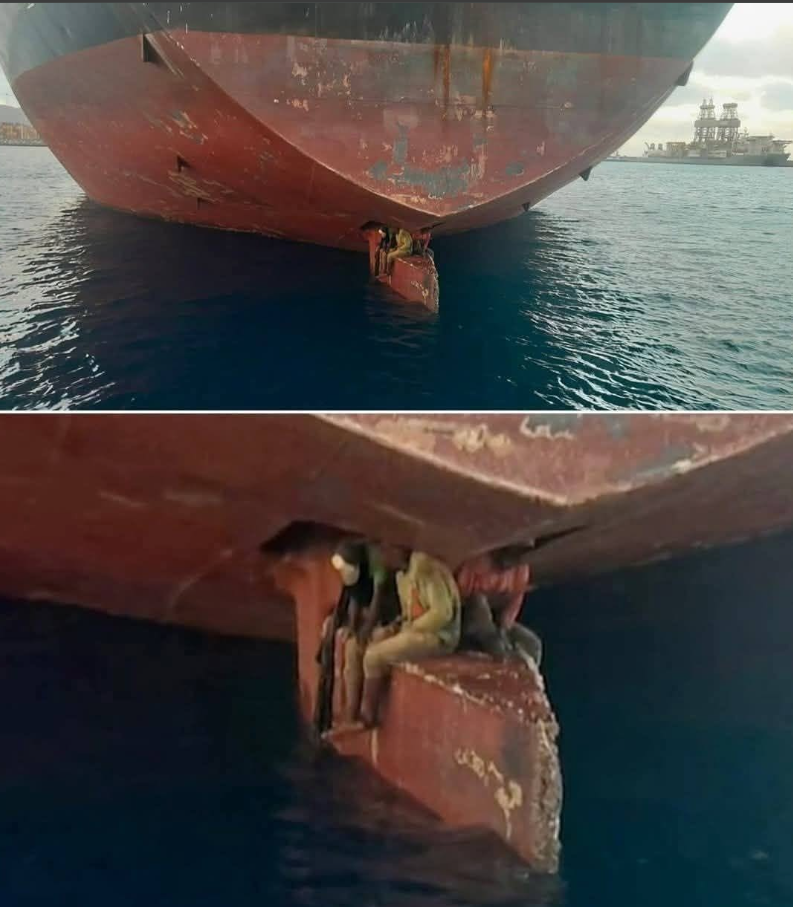
The image of three men perched on the rudder of a huge oil tanker immediately raises questions.
How did they get there?
How long had they been there?
What did they eat?
How did they sleep?
Were they afraid?
What made them decide that this was worth attempting?
And perhaps the most difficult question:
What circumstances made such an extraordinary risk seem worth taking?
Those questions do not have simple answers.
But they are important questions.
Final Thoughts
The story of the three Nigerian men who survived an eleven-day journey on the rudder of an oil tanker is one of the most extraordinary survival stories associated with migration.
They traveled thousands of miles across the Atlantic in a position that offered almost no protection from the elements.
They endured hunger, dehydration, exhaustion, wind, waves and extreme exposure.
When the Alithini II finally reached the Canary Islands, they were discovered by authorities and brought to safety.
Their survival should not encourage others to attempt similar journeys.
Instead, it should remind us of how dangerous irregular migration routes can become—and of the human desperation that sometimes exists behind decisions that appear impossible from the outside.
Three men.
One enormous ocean.
Eleven days of uncertainty.
And, against extraordinary odds, they reached land alive.
Sometimes the most powerful survival stories are not about defeating an enemy or winning a battle.
They are simply about holding on long enough to see another day.