
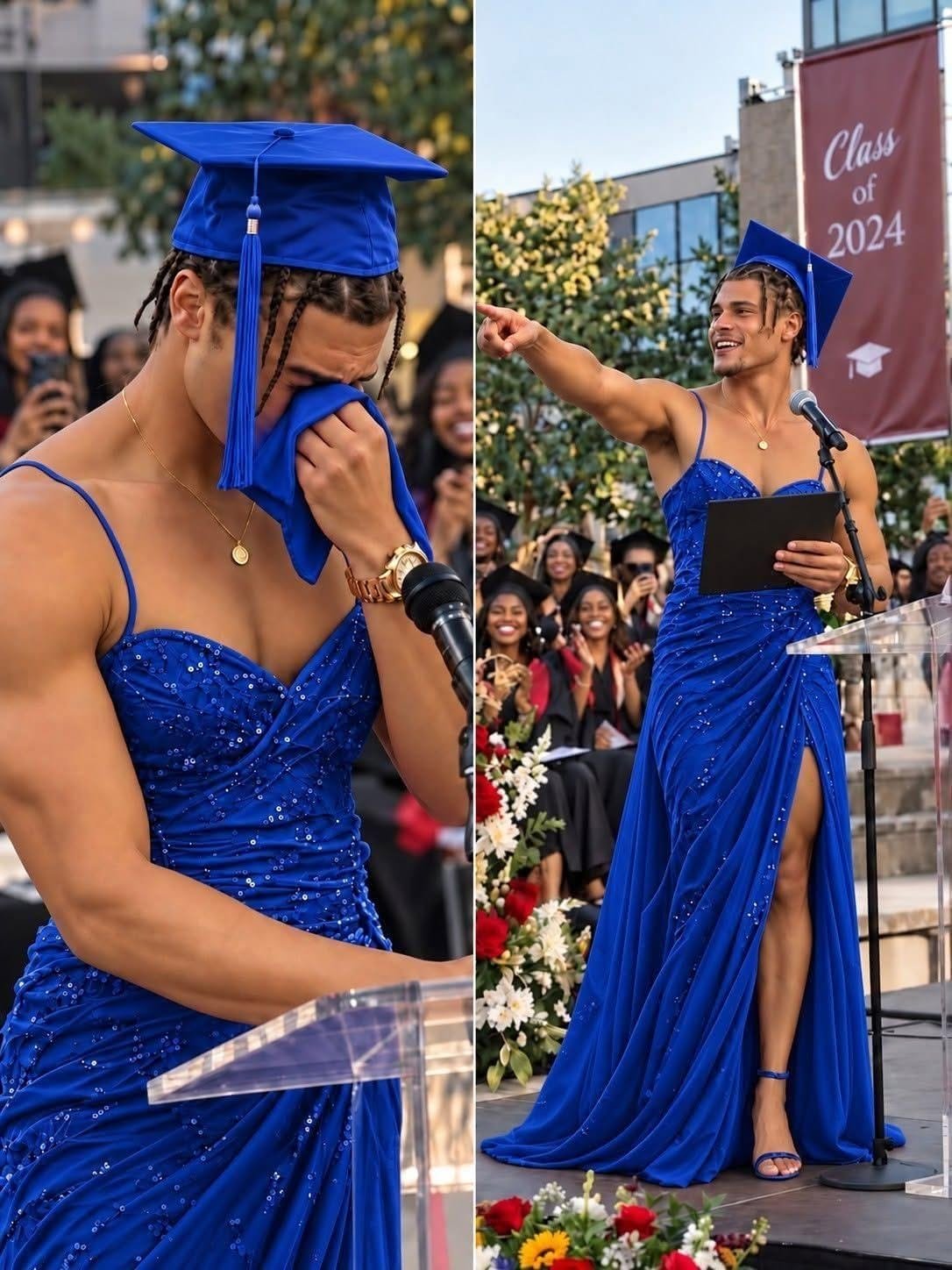
The laughter started before Aaron even reached the principal.
I heard it from the third row.
At first, it was only a few scattered sounds—quiet giggles, a whispered comment, a chair shifting as someone leaned toward a friend.

Then a student near the aisle said something loudly enough for several people to hear.
“What is he wearing?”
Someone else laughed.
A phone appeared.
Then another.
I stopped listening to the graduation speaker entirely.
My eyes were fixed on my son.
Aaron was eighteen years old, standing behind a line of students waiting for their names to be called. He was tall now, much taller than me. His dark hair had been carefully combed that morning. His hands were folded in front of him.
And he was wearing a bright red dress.
Not a costume.
Not a joke.
Not something thrown together at the last minute.
It was a beautiful red dress with simple lines, a fitted waist, and a soft skirt that moved slightly every time he walked.
I knew that dress.
I had seen it hanging in the back of my daughter’s closet.
I had folded it with trembling hands after she died.
I had placed it inside a garment bag because I could not bear to throw it away.
And now my son was wearing it.
Mary’s dress.
Mary’s graduation dress.
The dress she had chosen during one of the final ordinary afternoons of her life.
The dress she had told Aaron she wanted him to remember.
I looked at my husband.
His seat was empty.
He had refused to come.
He had said he couldn’t watch our son “make a spectacle” of the family.
Aaron’s closest friend, Ben, was not sitting beside him either.
He had stopped answering Aaron’s messages weeks earlier.
Even the school had suggested that Aaron reconsider.
But Aaron had refused.
And now he was walking across the stage in red.
A few students laughed.
A few adults looked uncomfortable.
Several parents lifted their phones.
Someone muttered that it was inappropriate.
Aaron heard all of it.
I knew he did.
His shoulders tightened for half a second.
Then he took another step.
He kept walking.
His eyes never left the principal.
But I knew what he was really looking for.
Me.
Before the ceremony had started that morning, Aaron had stood in my bedroom doorway holding the dress.
“Mom?”
I turned.
He was pale.

“Will you do something for me?”
“Anything.”
“Stay where I can see you.”
I had smiled through tears.
“I will.”
He nodded.
“Then I can do it.”
At the time, I thought I understood what he meant.
I didn’t.
Not completely.
I understood only after he received his diploma.
He walked toward the edge of the stage, reached into the pocket of Mary’s red dress, and pulled out a small tissue-wrapped bundle.
Then he walked directly toward me.
The auditorium had gone strangely quiet.
He stopped in front of me.
His hands were shaking.
“Mum,” he whispered.
Then he placed the bundle in my hands.
I opened it.
Inside was a pressed yellow daisy.
And beneath it was a folded letter.
I knew Mary’s handwriting immediately.
My breath disappeared.
Aaron looked at me.
“She wanted you to have this.”
I unfolded the paper.
The first sentence nearly broke me.
Mom, if I’m not there when graduation comes, please don’t think I’m gone from it.
I looked up at my son.
The auditorium was silent now.
Not one person was laughing.
Because suddenly, the red dress was no longer a strange outfit.
It was a story.
A story about two children.
A story about a sister who knew she might not live long enough to graduate.
A story about a brother who carried her promise onto the stage.
And a story about a mother who had spent years grieving one child without realizing how desperately the other child had been trying to grieve beside her.
This is the story of that dress.
This is the story of Mary.

And this is the story of the day my son taught an entire room of people that grief does not always look the way they expect.
Chapter One: Before the Hospital
Before Mary became sick, our family was ordinary.
Not perfect.
Not wealthy.
Not especially remarkable.
Just a family.
My husband Daniel and I had been married for more than twenty years.
We had learned how to argue about small things without destroying the big things.
We had learned how to survive financial problems.
We had learned how to apologize.
And we had learned that raising children was an endless process of believing you were prepared and discovering you weren’t.
Our twins, Mary and Aaron, had been born twelve minutes apart.
Mary was older.
She never let Aaron forget it.
“I’ve been your big sister for twelve whole minutes,” she used to tell him.
Aaron would roll his eyes.
“That’s not impressive.”
“It is when you’re the younger one.”
“You’ve been older than me for your whole life.”
“Exactly.”
Then she’d smile.
“I have seniority.”
Aaron would laugh.
They were different in almost every obvious way.
Mary was organized.
Aaron was spontaneous.
Mary planned.
Aaron improvised.
Mary kept lists.
Aaron forgot where he put his phone approximately every six hours.
Mary loved bright colors.
Aaron preferred black, gray, and navy.
Mary talked when she was nervous.
Aaron became quiet.
Yet somehow they fit together.
They fought constantly when they were younger.
Over toys.
Over television.
Over bathroom time.
Over who had eaten the last cookie.
But whenever someone outside the family hurt one of them, the other became fiercely protective.
I remember when they were eleven.
A boy at school made fun of Aaron for being quiet.
Mary confronted him.
“Don’t talk to my brother like that.”
The boy laughed.
“You’re not his mother.”
Mary shrugged.