
It all began with a simple household mission: rescuing a stray LEGO piece that had disappeared beneath the bookshelf.
That dusty stretch of floor was a familiar no-man’s-land where small toys went to be forgotten. Armed with a pencil—my standard tool for investigating mysterious objects under furniture—I crouched down and began searching. I fully expected to encounter a sharp plastic brick, the kind capable of making a barefoot adult question every decision that had led to that moment.
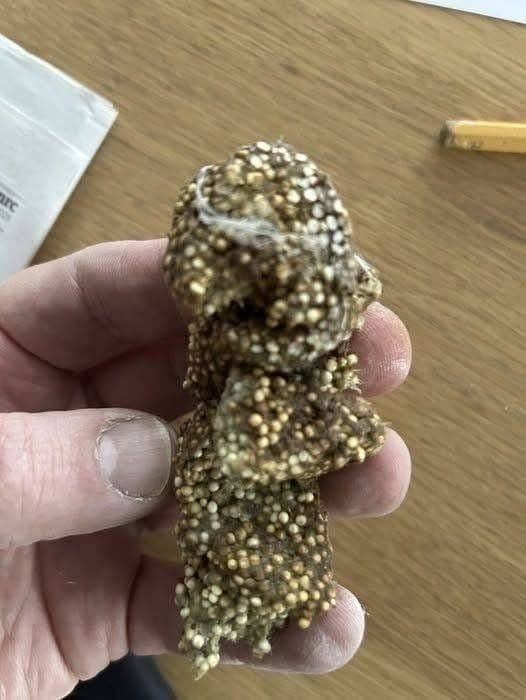
Instead, my pencil met something strange.
It wasn’t hard or angular. It was a lumpy mass wedged into a corner, with a texture that seemed crunchy and vaguely rubbery at the same time.
My heart jumped.
Please don’t be a mouse, I thought. Please, please don’t be a mouse.
I nudged it again. Nothing moved.
Thankfully, there was no unpleasant smell. Just dust and the faintest trace of something oddly familiar—a synthetic scent that seemed to belong to another decade.
Then recognition struck.
It wasn’t an animal.
It was Floam.
If that word means nothing to you, imagine a brightly colored putty packed with thousands of tiny foam beads. For kids like me, growing up in the 1990s, it was a small tub of endless possibilities, wrapped in the promise of Nickelodeon-style messy fun.
You could shape it into a spaceship, wrap it around a plastic toy, or press it into places your parents desperately wished you wouldn’t. It squished, stretched, and broke apart between sticky fingers in a way that somehow never stopped being entertaining.
It was slime’s bumpy cousin and the reason someone in the house was always asking, “What is that stuck to the carpet?”
I remembered begging my mother for a tub whenever an advertisement appeared during a Rugrats commercial break. Those commercials knew exactly what they were doing.
When I finally got one, I felt as though I had won the lottery.
My first creation was a crooked saddle for a plastic stegosaurus.
Why did a stegosaurus need a saddle?
I was a child. That was reason enough.
The specimen I discovered beneath the bookshelf in 2025 had lost most of its original charm.
It resembled a piece of fruitcake that someone had abandoned and then deliberately forgotten. What I suspected had once been bright pink had faded into a shade best described as “apricot regret.”
Its texture was somewhere between a stale crouton and chewing gum left beneath a school desk.
Yet the tiny foam beads remained, stubbornly embedded in the dried putty like little time travelers who had refused to abandon their mission.
I lifted it with the solemn wonder of someone pulling Excalibur from a stone.
“Behold,” I announced to my son, “the Holy Floam of 1999.”
He stared at the crusty lump in my hand.
“Why is it crunchy?”
It was an excellent question.
For a moment, doubt returned. Was I absolutely sure this was an old toy? Could it be something an animal had dragged inside? Had I just picked up a strange insect nursery?
My imagination was already reaching for the pest-control number when another memory surfaced.
In the late 1990s, I had owned enough Floam to supply half the children in my neighborhood. I knew those tiny beads. I remembered that peculiar texture.
This was no mysterious intruder.
It was a relic of my childhood.
And once I recognized it, something changed.
The disgust softened. The ridiculous little lump in my hand became more than an overdue cleaning discovery.
It brought back Saturday mornings.
I could almost hear cartoons playing too loudly in the living room. I pictured glitter glue drying on the coffee table and remembered squeezing Gak just to hear the rude little noise that never failed to make me laugh.
Back then, my days weren’t organized around phone notifications or endless lists of things to do. There were bare feet on cool linoleum, toys scattered across the floor, and whole afternoons available for making something that served no useful purpose.
A dinosaur saddle could be the most important project of the day.
Nobody needed to approve of it. Nobody needed to photograph it. It didn’t have to become anything more than the thing I wanted to make.
My son is growing up in a different world.
He may never know the particular satisfaction of pressing Floam against a baseboard and watching his mother close her eyes with a weary sigh. He may never understand why a lopsided saddle for a plastic dinosaur once felt like a major creative achievement.
That’s all right. He will have his own toys, his own odd inventions, and his own memories of afternoons that seemed to last forever.
Still, standing beside him with that crumbly piece of my past, I felt an unexpected connection between the child I had been and the parent I had become.
For a moment, the years between those two versions of me felt surprisingly small.
Then came the practical question.
Was I going to keep it?
No.
I held on to it for exactly sixty-three seconds—long enough to examine it, announce its historical significance, and carry it over to my partner.
They looked at the crusty mass, blinked, and then looked at me.
“You’re not putting that in a shadowbox, are you?”
“Of course not,” I said.
I sounded almost convincing.
A moment later, the ancient Floam went into the trash.
Letting it go was easier than I expected. The memory had already returned; I didn’t need to keep the object to hold on to it.
I could remember the excitement of opening that first tub without preserving what remained of it beneath a layer of dust.
What stayed with me was the feeling of playing.
Floam had never required me to make anything impressive. My creations could be crooked, impractical, or completely unrecognizable, and I could still be delighted with them.
That play had been unscripted, unphotographed, and unshared. There were no likes to count and no audience to impress. There was simply a child sitting on the floor, shaping neon putty and tiny beads into whatever came to mind.
Somehow, a forgotten scrap beneath a bookshelf had brought that feeling back.
I had crouched down looking for a LEGO piece. Instead, I found a small reminder of how freely I once made things, before I worried about whether they were useful or worth showing anyone.
The Floam was gone, but the reminder remained.
Sometimes, a time machine looks less like a treasured heirloom and more like a crunchy, faded lump waiting in the dust.
And sometimes, the message it carries is simple:
Remember how light you used to feel?