
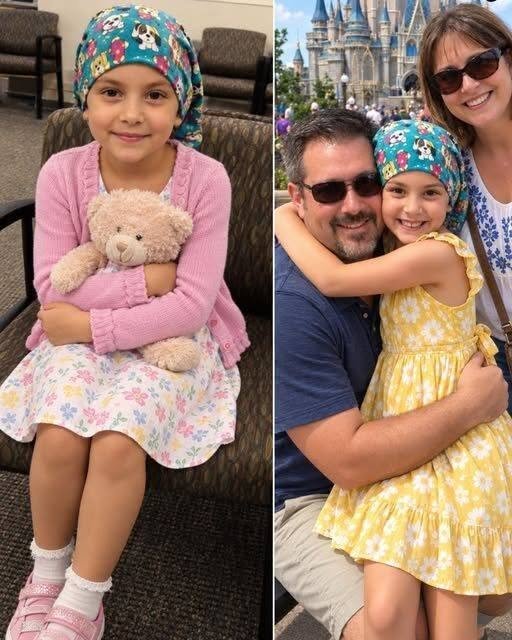
My daughter had one wish left in the world, and my husband tore his own hands raw trying to give it to her. Then, on our last morning in Florida, a hotel manager pressed an envelope into my palm and whispered, “Your husband should have told you.”
PART ONE: BEFORE TONY
Six weeks before my wedding to Adam, a drunk driver crossed the center line at sixty miles an hour and ended his life on a wet stretch of Route 9.
I was seven months pregnant. I buried him in a maternity dress because nothing else fit, and I remember almost nothing about that day except the sound the earth made when it hit the coffin lid — soft, final, wrong.
Lily was born into a house that already knew grief. For five years it was just the two of us, and I got good at it in the way you get good at anything you have no choice about. I learned to open jars with my knee while holding a baby. I learned to cry in the shower where the water hid it. I learned that “single mother” is a phrase people say gently, like it might break if they said it any other way.
Then my kitchen sink started leaking into the cabinet under it, and the apartment complex sent over a maintenance man named Tony.
Lily was five, and she followed him around the kitchen like a small, serious supervisor. “Do you fix everything?” she asked him. He was on his back under the sink, only his boots visible. “Most things,” he said. Not all things. Even then, he didn’t lie to her.
He came back the next week to check the pipe, though it didn’t need checking. He came back the week after that with a coloring book he’d bought for no reason he could explain. He never once asked Lily to call him anything. He never tried to stand in the space where Adam should have been.
He just kept showing up, the way water finds the lowest point in a room, quietly and without announcement, until one day I looked around and realized he was simply there — at school plays, at bedtime, at 3 a.m. when Lily woke up from a nightmare about monsters under the porch, sitting on the floor by her bed because she’d asked him to and he never once said he was tired.
He learned to braid hair badly. He learned which stuffed rabbit had to be tucked in first. He learned, without anyone teaching him, how to love a child who wasn’t his in a way that made it stop mattering whose she was.
We married two years later, in a backyard, with folding chairs and a cake that leaned slightly to one side. Lily stood beside us in a yellow dress. When we cut the cake, she reached up and wiped a smear of frosting from his sleeve with her small hand and said, without any warning at all, “Dad, you got frosting on your sleeve.”
Tony went completely still. I watched something move behind his eyes — hope and fear arriving at exactly the same moment, the way they do when you want something too much to trust it.
Lily noticed his silence and misread it. “Is that okay?” she asked, and her voice had gone small and worried, the voice of a child bracing to be told no.
Tony knelt down in his good shirt, right there on the grass in front of forty people, and took both of her hands. “It’s more than okay,” he said.
He excused himself ten minutes later and locked himself in the bathroom, and I found him afterward with his eyes red, trying to explain that he was fine, he was just — and then he couldn’t finish the sentence, because there wasn’t a sentence big enough. I didn’t need him to finish it. I already knew. Some men have to be given a child before they understand what their whole heart was for.

PART TWO: THE DIAGNOSIS
Six months after the wedding, Lily started sleeping too much. Then she began waking up with bruises on her shins and forearms that neither of us could account for — no falls, no bumps, nothing. I told myself it was growing. I told myself a lot of things that fall, all of them wrong.
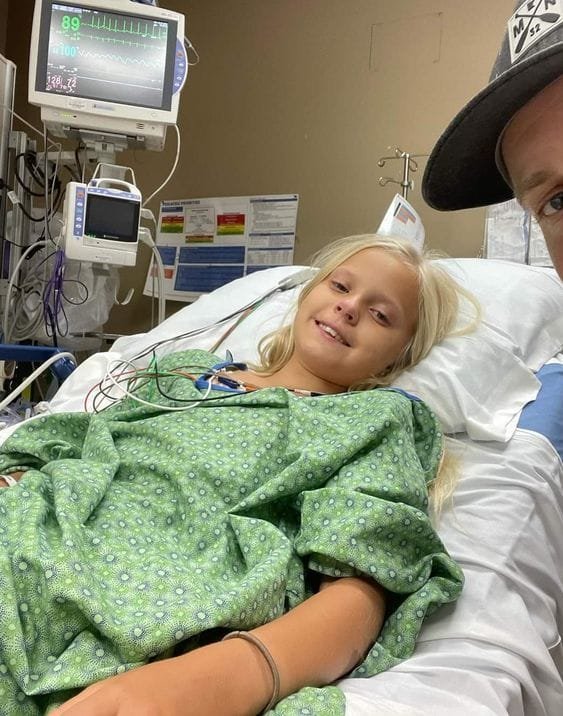
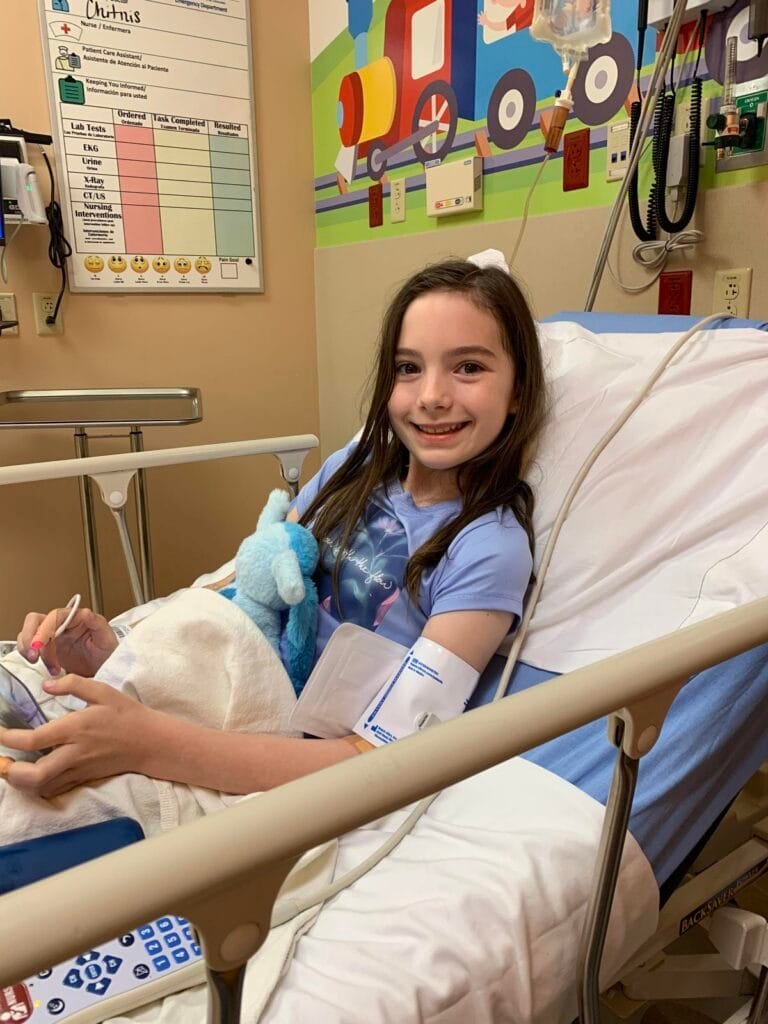
The diagnosis came on a Thursday morning, in a room with a poster of a smiling cartoon sun on the wall, as if anyone in that building was ever smiling. Leukemia. Lily was eight years old. I remember Tony’s hand finding mine under the little plastic table and gripping it hard enough to hurt, and being grateful for the pain, because it was the only thing keeping me upright.
The two years that followed became their own kind of life — a life measured in blood counts and IV drips and the particular silence of hospital hallways at 2 a.m. Tony never once treated it as my burden to carry alone. He learned the names of every medication.
He learned to read the monitors before the nurses explained them. By the time Lily turned ten, she had spent more days in a hospital bed than she had spent outside playing, and something in all of us had quietly rearranged itself around that fact, the way a tree grows around a fence post because there’s no other direction left to grow.
She used to sit at the window of her hospital room and watch the kids in the park across the street playing soccer, their voices carrying faintly through the glass. “Dad, why can’t I play like the other kids?” she asked once, not accusing, just wanting to understand the rules of a world that had stopped making sense to her.
Tony sat beside her and took her hand, the way he always did, like her hand was the only thing anchoring him to the room. “Your body needs more rest than theirs does right now,” he told her.
“That is not fair.”
“No,” he said, and his voice cracked on the single syllable in a way I don’t think she noticed but I never forgot. “It is not.”
One afternoon she turned to me instead, and asked the question in a voice so quiet I almost missed it. “When will I be normal again?”
I could not answer her. I turned to the window because I could feel my face failing to hold its shape, and a mother is not supposed to let her child see that kind of failure.
Dr. Patel called us in the following week, alone, without Lily. “The treatments are no longer working the way we’d hoped,” she said, and there is a particular gentleness doctors use for sentences like that, a gentleness that somehow makes it worse. “More treatment at this point may cause her pain without giving her meaningful time.”
Tony put his hand over his mouth. I was the one who found the words, because someone had to. “How long?”
There was no exact answer. Months, maybe. Perhaps less.
Lily already knew more than we had ever told her — children in hospitals learn to read faces the way other children learn to read books. That evening, once we were home and the day had gone quiet around us, she waited until we were both in the room and asked the question directly. “Am I dying?”
Tony sat on one side of her bed. I sat on the other. I wanted so badly to lie to her, to give her the version of the truth that let her sleep easy, but I took her small hand instead and told her the only thing I could stand behind. “The medicine isn’t helping anymore, baby.”
She looked at her blanket for a long moment. “So, yes?”
“We don’t know how much time we have,” I said, and it was the most honest sentence I had spoken in months, and it broke something open in all three of us at once.
She cried quietly, the way she’d learned to do everything by then — quietly, so as not to worry us more than we already were. Tony cried too, and did not try to hide it from her, which I think mattered more than anything else he did that year.
Later, after the worst of the fear had drained out of the room enough for words again, Lily said, “I want to see Cinderella’s castle.”
Tony wiped his face with the back of his hand. “The one in Florida?”
“And I want to put my feet in the ocean.”