
There are moments in life when one decision quietly changes everything that follows. Not with noise or drama, but with a sentence spoken too quickly, a belief held too tightly, or a fear allowed to grow unchecked. For one father, that moment came not with anger or betrayal, but with doubt, and it shaped the rest of his life in ways he never imagined.
This is a story about trust, responsibility, and the long shadow cast by choices made during moments of emotional exhaustion. It is not about blame alone, but about how easily love can unravel when certainty replaces communication.
class="wp-block-heading">A Home Built on Hope
The nursery had been painted a soft yellow, chosen carefully because it felt warm and welcoming. Sunlight filtered through the curtains each afternoon, landing on the white crib that stood beneath the window. I remembered assembling that crib with my wife, Emma, months before our son was born. We had laughed at my confusion over the instructions. She had taken over patiently, finishing what I could not, while I handed her parts and pretended not to mind.
Two weeks after our son arrived, I stood alone in that same room, listening to his gentle breathing as he slept. Instead of joy, a heavy stillness settled over me. Something inside my chest felt off, unsettled. I had been distant for days, unable to explain why.
Emma appeared in the doorway, her face tired from sleepless nights. She wore the oversized sweater she lived in since coming home from the hospital. Her hair was pulled back without thought. She looked like a new mother doing her best.
She asked me what was wrong.
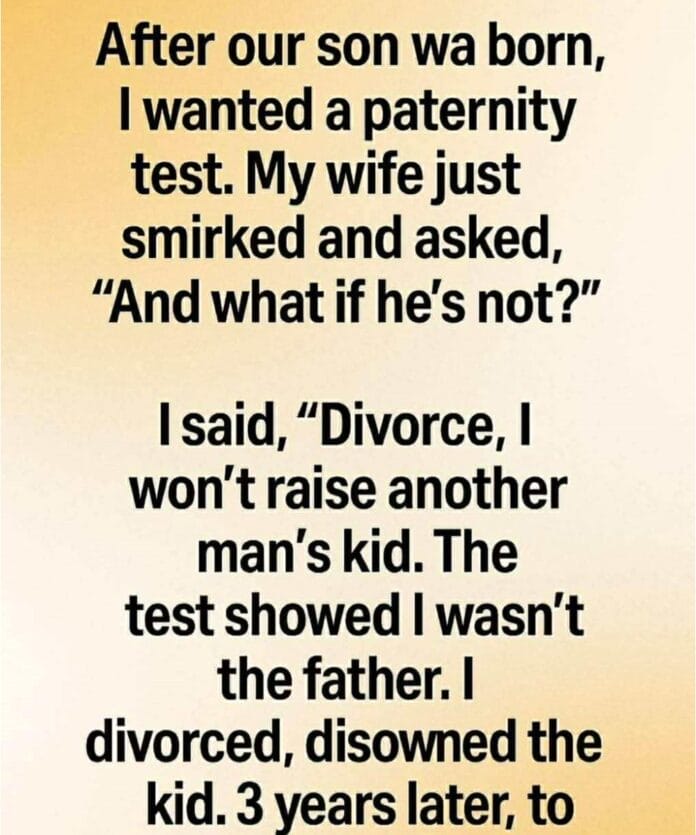
Instead of answering honestly, I held out a box that felt far heavier than it should have. Inside was a paternity test kit.
When Fear Speaks Louder Than Love
Emma stared at the box, confused. When she realized what it was, the color drained from her face.
I told her I needed to know if the baby was mine.
The room went quiet. The clock in the hallway ticked steadily. Our son shifted in his sleep.
She did not raise her voice. She did not argue. She asked one question, softly.
What would happen if the test said he was not mine?
I answered without hesitation. I said I would leave. I said I would not raise another man’s child.
Even as the words left my mouth, something in me knew they were too sharp, too final. Still, I clung to them as if they offered protection.
Emma nodded slowly. She took the kit from my hand and left the room without another word.
In that moment, I felt a strange sense of control, as if certainty itself were a kind of strength. I did not recognize how empty that feeling truly was.
Waiting for Proof
The days that followed were cold and quiet. We shared the same house but lived as strangers. Emma cared for our baby with calm efficiency. She spoke only when necessary. I told myself her silence meant guilt. I convinced myself that the test would confirm everything I already believed.
When the envelope arrived, I opened it alone in my car, parked in the driveway.
The words were clear.
The test stated I was not the biological father.
I felt both justified and hollow. I had been right, and yet nothing about it felt like relief.
Inside the house, Emma was preparing lunch. She saw my expression and knew before I spoke.
I told her the result.
She tried to say my name, but I cut her off. I said I did not want explanations. I said I was leaving.
She looked at me for a long moment, then said something I would remember for years.
She told me I had already decided who she was, long before the test. The paper had simply given me permission.
I did not respond. I packed my things and left days later. I filed for divorce. I told people she had been unfaithful. I blocked her attempts to reach me. Anyone who questioned my version of events was removed from my life.
I told myself I was protecting my dignity.
Years of Believing I Was Right
For three years, I lived confidently in the story I had built. I advanced in my career. I moved into a downtown apartment. I dated casually. I told myself I was free from a situation that would have destroyed me.
Yet late at night, when the city grew quiet, memories crept in. Emma standing in the nursery. The way she had looked at me when I handed her the test. Not angry. Not defensive. Just deeply hurt.
I pushed those thoughts away. Science had proven my case, or so I believed.
Then I ran into an old friend.
The Truth I Was Not Ready For
Thomas had known us since college. He had attended our wedding and sent a gift when our son was born. When I saw him in a café one morning, his expression was not hostile. It was disappointed.
He asked me if I had ever considered the test could have been wrong.
I dismissed the idea immediately. I trusted the lab. I trusted the result.
Thomas told me calmly that the test had been incorrect. There had been an error during processing. Emma had spent months proving it. By the time she had answers, I was gone.
The child I had walked away from was mine.
I felt as if the ground had shifted beneath me. Thomas explained that Emma had never been unfaithful. She had tried to reach me. I had blocked every path.
He told me she finished nursing school. She was raising our son on her own. The boy was three years old and looked just like I had as a child.
I asked to see them.
Thomas told me I would need another test first, and even then, forgiveness was not guaranteed.
Facing Reality at Last
It took weeks to find Emma. When I finally sent a letter, her response was brief. A date. A clinic. Nothing else.
The second test was quick. The results were definitive.
I was the father.
I wrote apologies. I explained myself. I sent letters filled with regret and responsibility.
None were answered.
On our son’s fourth birthday, I sent a card. It came back unopened.
That was when I understood something painful but necessary. Healing does not always include the person who caused the harm.
Learning to Live With Consequences
Once, I drove past my son’s school. I saw him laughing, his backpack bouncing as he ran toward Emma. She knelt to hug him, whole and steady.
They looked complete.
I left before they noticed.
Therapy helped me see what I had avoided for years. I had not left because of betrayal. I had left because of fear. I had mistaken suspicion for certainty and allowed doubt to overpower love.
Now, I write letters to my son that I may never send. I contribute quietly to a trust in his name. I do not expect gratitude or forgiveness.
I live with the lesson carved into me slowly and deeply.
Love cannot survive without trust.
If my son ever asks why I was not there, I will tell him the truth. I was afraid. His mother deserved better. And my doubt cost us all something precious.
All I can do now is learn, change, and accept what cannot be undone.